
PNR
Nursing is considered one of the most valued and prestigious vocations globally. The State of the World’s Nursing 2025 report shows that, in 2023, there were around 298 lakh nurses worldwide. However, the world struggled with a shortage of about 58 lakh nurses. The International Council of Nurses (ICN) states that the world needs over 130 lakh nurses by 2030 to close the gap in this.
This worldwide shortage opens up new doors for Nepali nurses who want to work. The nursing education system in Nepal trains skilled experts who are appreciated more and more for their strong medical skills and commitment. The number of Nepali nurses who are migrating abroad as a nurse has increased due to growth in their careers, earning much higher salaries, and enjoying a healthier balance between work and personal life.
Out of all the countries, Finland, Ireland, and Canada stand out as the top destinations for migrating abroad as a nurse. These countries provide specific benefits that make moving there worthwhile and long-lasting.
Key Advantages of Migrating Abroad as a Nurse
Higher Pay and Financial Security
International nursing jobs bring big financial advantages over local ones. Nurses in Nepal face low pay, but working abroad means earning 10 to 15 times more. This income helps them take care of their families and save for their future.
International Healthcare Training Specifications
Nurse practice in advanced healthcare environments offers experience with the latest medical technology. They pick up skills from using evidence-based practices and international guidelines. These experiences can lead to earning certifications valued worldwide.
Pathway to Permanent Residency
Developed nations seek healthcare workers and provide clear ways to gain permanent residency. This creates a stable future for nurses while still allowing them chances to visit Nepal.
Safe and Supportive Work Environments
Typically, global healthcare facilities maintain high safety protocols, adequate staffing, and zero-tolerance work harassment policies. These work environments respect nurses’ well-being and ongoing professional improvement.
Work-Life Balance and Social Benefits
Advanced countries facilitate work-life balance through controlled working hours, set rest periods, universal health insurance coverage, and liberal vacation requirements. Funds for career growth and support for planning retirement are also common.
Why is Finland the optimal destination for migrating abroad as a nurse?
Finland’s healthcare system stands out globally, giving nurses great chances to build rewarding careers.
- Strong Healthcare System: Finland has a comprehensive public healthcare system with high patient satisfaction and advanced healthcare facilities spread all over the country.
- Nurse Demand Is Extremely High: Finland provides attractive salaries of over 60,000 euros for nurses and has acute vacancies generating plenty of work opportunities.
- Parental Leave and Social Benefits: Finland provides up to 164 days of parental leave, complimentary health care, and complete social security coverage. For working evening shifts, you’ll earn an additional 30-45% per hour. Working night shifts can increase pay by 30 to 45 percent per hour.
Other Benefits: Finland gives up to 164 days of parental leave and offers free healthcare and strong social security.
- Door to Permanent Resident: Nurses who work in Finland for at least four consecutive years are eligible to apply for permanent residency. The application process is also simple for healthcare professionals as compared to others, as they are counted as skilled workers of the nation.
Why is Ireland the optimal destination for migrating abroad as a nurse?
Ireland, one of the English-speaking EU countries, surrounded by peaceful nature, gives unique advantages for international nurses.
- Worldwide Reputation: Ireland accepts other countries’ qualifications in nursing and has made registration procedures easier for overseas qualified registrants.
- Multicultural Healthcare Environment: The multicultural healthcare workforce in Ireland embraces overseas individuals and fosters supportive societies for migrant nurses.
- Decent Pay Scales: The average nurse can earn about $49,504 per annum. They can work in the public sector, funded by the government, or join the private sector to try to earn higher pay. A nurse’s salary in Ireland ranges between $34,000 and $38,500.
- Opportunities for Career Advancement: The booming healthcare sector in Ireland provides huge specialization opportunities for international nurses and increases chances for direct promotion for nurses with relevant expertise.
Why is Canada the optimal destination for migrating abroad as a nurse?
Canada ranks among the best places for healthcare professionals, as it offers high pay, an easy PR pathway, and world-class technologies, including other international opportunities.
- Demand for Nursing Professionals: With increasing demand in Canada, registered nurses expect to earn an average annual salary between $60,000 and $70,000 each year, and the pay can be even higher depending on the level of expertise and experience.
- Diversified Practice Site: Canada offers diverse practice sites ranging from urban teaching hospitals to rural community health clinics to suit various tastes and career goals.
- Clear PR Channel: Provincial Nominee programs actively recruit healthcare professionals and provide fast-tracking permanent residency to eligible nurses.
- Family Migration Support: Family-based Canadian migration policy facilitates nurse migration with spouse and child sponsorship for full family transfer.
Comparative Study: Finland, Ireland, and Canada
This includes a close examination of salient points relevant to nurses considering international migration.
| Factor | Finland | Ireland | Canada |
| Average Salary | €50,000-€60,000 | €35,000-€49,500 | CAD $60,000-$70,000 |
| Language Requirement | Finnish (YKI Level 3) | English (IELTS 7.0+) | English/French (CLB 7+) |
| PR Timeline | 4 years of continuous residence | 5 years of legal residence | 1-2 years (PNP) |
| Cost of Living | High | Moderate-High | Moderate |
| Work-Life Balance | Excellent | Good | Good |
| Family Migration | Supported | Supported | Highly Supported |
| Processing Time | 6-12 months | 3-6 months | 6-18 months |
Note: Salaries are approximated to rough USD equivalents using prevailing currency conversion rates. Processing time is comparative and may vary with respect to extraordinary situations, completeness of documents, and application volumes during certain seasons.
Practical Guidelines to Implement Before Migrating Abroad as a Nurse
Checklist with Country-Specific Timeline
Planning depends on understanding the timeline of each country for migration.
| Timeline Phase | Finland (12-18 months) | Ireland (6-9 months) | Canada (12-24 months) |
| Phase 1 | Months 1-3: Language learning & credential evaluation | Months 1-2: NMBI registration application | Months 1-6: Provincial nursing license application |
| Phase 2 | Months 4-6: Complete competency examination | Months 3-4: IELTS examination & job applications | Months 7-12: Language tests & Express Entry profile |
| Phase 3 | Months 7-9: Job search & employment contract | Months 5-6: Employment contract & work permit | Months 13-18: Provincial nomination application |
| Phase 4 | Months 10-12: Residence permit application | Months 7-9: Relocation & final registration | Months 19-24: Federal PR application & relocation |
| Phase 5 | Months 13-18: Relocation & registration | – | – |
Note: All the values are approximate, and each country has its own steps and timeline that decide how long the process will be. It is always relevant to add an extra 2-3 months to your schedule.
Licensing Process of Each Country (Step-by-Step)
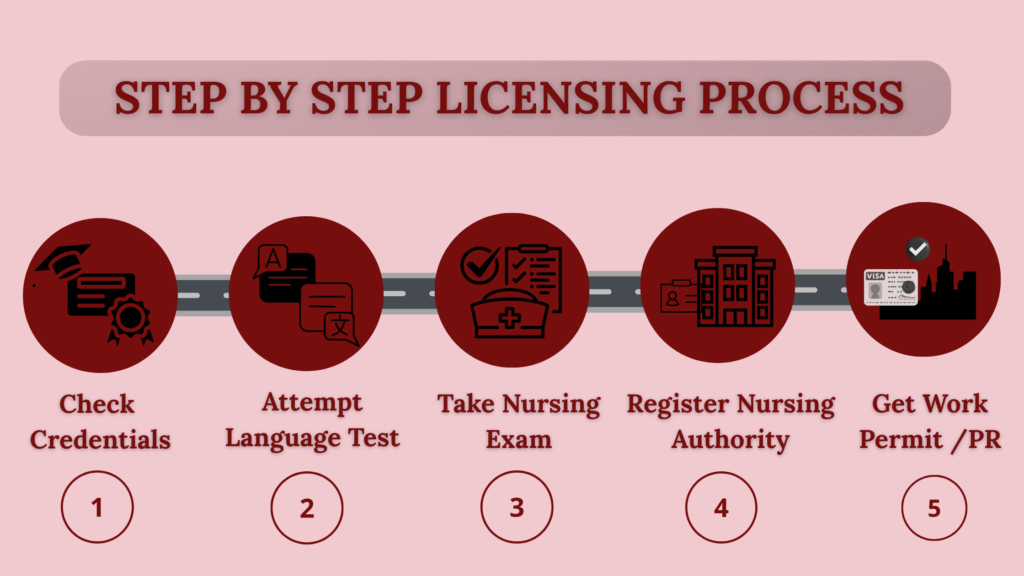
Finland:
- Get your credential evaluation from the Finnish National Agency for Education.
- Take a Finnish language test and pass with YKI level 3.
- Pass the nursing competency exam (if necessary).
- Register yourself under Valvira, the National Supervisory Authority for Welfare and Health.
- Apply for a work residence permit.
Ireland:
- Apply for registration with the Nursing and Midwifery Board of Ireland (NMBI)
- Provide proof of your education and work history.
- Take the IELTS Academic test with a score of at least 7.0.
- Complete a competency test or adaptation period if needed.
- Obtain a job offer as well as a work permit.
Canada:
- Begin the process by applying to the nursing regulatory body of your chosen province.
- Have your credentials evaluated through the National Nursing Assessment Service (NNAS).
- Pass an approved language test like CELBAN, IELTS, or CELPIP.
- Join the full bridging program (if needed).
- Apply for permanent residence through Express Entry/PNP.
Language Competence and Test Preparedness
Step 1: Evaluate the Existing Linguistic Proficiency.
- Administer diagnostic assessments to determine areas of proficiency and deficiency.
- Set a realistic timeline based on your proficiency level.
Step 2: Choose Preparation Method
- Enroll in language courses (online or classroom).
- Use only official preparation materials and practice tests; don’t go for cheap or third-party resources.
- Join study groups or find language exchange partners to amplify your language skills.
Step 3: Focus on Medical Terminology
- Study medical vocabulary specific to your destination country.
- Practice communication with patients to understand each case and scenario.
- Understand healthcare rules and procedures for the specific country that you have planned.
Step 4: Take Practice Tests
- Complete multiple mock exams using a timer for an easier time dividing.
- Identify areas that need extra work for improvement.
- Find out your weak areas and focus your revision on those.
Step 5: Prepare yourself to register for the official exam
- Do thorough research and book exam dates in advance.
- Ensure all documentation is ready before leaving for the exam.
- If you fail in the first attempt, plan for multiple attempts (according to your needs).
Financial Planning
Proper, structured financial planning is beneficial while you are migrating abroad as a nurse from Nepal. Here is a brief, comprehensive breakdown of expenses throughout your journey.
| Expense Category | Finland | Ireland | Canada |
| Language Tests | $350-$550 | $300-$400 | $400-$600 |
| Credential Assessment | $220-$440 | $330-$550 | $600-$800 |
| Licensing Exams | $550-$880 | $440-$660 | $800-$1,200 |
| Application Fees | $240-$360 | $440-$3,850 | $2,000-$3,000 |
| Medical Examinations | $330-$550 | $220-$440 | $400-$600 |
| Document Translation | $220-$440 | $165-$330 | $300-$500 |
| Flight Tickets | $1,200-$1,800 | $800-$1,200 | $1,500-$2,200 |
| Initial Accommodation | $2,200-$3,300 | $1,650-$2,750 | $2,500-$4,000 |
| Living Expenses (3 months) | $4,400-$6,600 | $3,300-$4,950 | $4,000-$6,000 |
| Emergency Fund | $2,200-$3,300 | $1,650-$2,200 | $2,000-$3,000 |
| Total Estimated Cost | $12,900-$19,700 | $9,625-$14,500 | $14,500-$22,400 |
Note: The costs mentioned are estimates sourced from official data. Finland’s fee for a permanent residence permit is €220 ($240). Ireland’s NMBI registration can range between €400 and €3,500 ($440-$3,850). IELTS has a fee of €230 ($250). Actual costs may vary based on individual circumstances, exchange rates, and specific requirements.
Challenges and How to Overcome Them
Cultural Adaptation Tips
Look for online groups of Nepali nurses already living in the country you are headed to. These groups share helpful advice, cultural knowledge, and emotional encouragement for newcomers adjusting to life abroad.
Get to know the issues that come along with professional registration
Every country has its own rules for registering healthcare workers. Begin the process, keep organized records, and think about getting help from immigration experts who understand healthcare-related requirements.
Early Settlement Problems
Sorting out temporary housing, opening a bank account, and registering for healthcare can feel stressful at first. You should always do research, have a pre-plan for all requirements, and connect with local Nepali communities that are already established there for proper guidance.
Remaining Connected to Home
Regular contact, regular visits, and membership in an overseas community can make you feel connected to your hometown. Nepali culture groups help maintain close connections to families, culture, and create new lives overseas.
Conclusion
Nepali nurses who are thinking of migrating abroad as a nurse can find Finland, Ireland, and Canada to be outstanding choices. Each country comes with its own strengths. Finland provides strong social benefits, Ireland offers the advantage of being an English-speaking country within the EU, and Canada is welcoming with its family-focused immigration policies.
The shortage of nurses globally generates a distinct need for competent practitioners, and it is a prime time for skilled Nepali nurses to seek global work prospects. This makes it a great moment for Nepali nurses to look into working in other countries. Challenges may come up, but being well-prepared, staying realistic, and building a solid support network can make the move smoother.
To find better careers, secure finances, and live a higher quality of life. Nepali nurses can choose these three countries to grow and develop. Though migration requires effort and time, it results in better career opportunities and improved living conditions.
Take Your First Step with Expert Guidance
Whereas the process of migration may seem to be complicated, you need not go through it alone. PNR Immigration Service has become the keynote consultancy firm in Nepal for healthcare professionals with specialized knowledge of the migration of nursing staff to Denmark, Norway, Australia, and Canada.
The experienced counselors at PNR Immigration Service provide comprehensive help from initial evaluation to application for permanent residency so that nurses can avoid common pitfalls and ensure all documents meet international standards. The migration process might feel overwhelming, but you don’t have to handle it on your own.
Take time, study extensively, plan methodically, and think about working with veteran experts who can steer you toward an international nursing career. This path could bring both personal satisfaction and career growth.
Want to begin your journey? Visit PNR Immigration Service to learn how we help you throughout your journey of migrating abroad as a nurse.
IMPORTANT NOTICE !!!

This will close in 15 seconds